


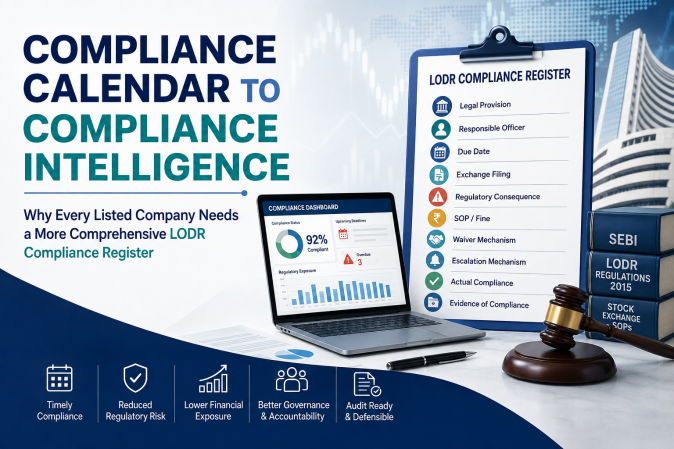
This article explores how listed companies can transform LODR compliance registers from routine filing calendars into comprehensive tools for accountability, risk management, governance and regulatory preparedness.
COMPLIANCE CALENDAR TO COMPLIANCE INTELLIGENCE
"Why Every Listed Company Needs a More Comprehensive LODR Compliance Register"
Introduction
For a listed company, the LODR Compliance Register is generally viewed as a record of recurring obligations, due dates and filing status. In practice, however, it should be much more than a calendar maintained by the secretarial department.
The regulatory environment for listed entities has become increasingly compliance-driven. The stock exchanges are specifically required to monitor compliance by listed entities and the adequacy and accuracy of their disclosures under Regulation 97 of the SEBI (Listing Obligations and Disclosure Requirements) Regulations, 2015. Regulation 98 further provides for action by the stock exchanges, including fines, in addition to liability under securities laws.
This regulatory architecture makes it important for companies to reconsider the purpose and design of their compliance registers.
A good compliance register should not merely answer what is required and when it is due. It should also answer who is responsible, what is required to be filed, what happens if there is a default, what financial exposure may arise, how a delay should be escalated, when the compliance was actually completed and where the evidence is maintained.
The compliance register should therefore evolve from a filing calendar into a governance and risk-management tool.
From Compliance Tracking to Compliance Ownership
The first requirement of an effective compliance system is to identify the precise legal source of every obligation. A compliance entry should not merely state "quarterly results" or "shareholding pattern". It should identify the applicable regulation, schedule, circular or stock-exchange requirement.
This legal mapping is important because the LODR framework is amended from time to time. The official SEBI record shows that the LODR Regulations were amended again in 2026. A register that is not periodically updated can therefore become inaccurate even though the filing calendar appears to be complete.
The next question should be who owns the compliance. Responsibility should not simply be assigned to "Finance", "Secretarial" or "Legal". There should be an identifiable officer responsible for providing the information, reviewing it and ensuring that the final compliance is completed. Where several departments are involved, their respective responsibilities should be clearly defined.
This creates accountability and prevents the familiar situation in which everyone assumes that someone else is dealing with the requirement.
The Due Date Is Only One Part of the Obligation
The register should record the actual due date applicable to the particular compliance rather than merely mentioning that it is a quarterly, half-yearly or annual requirement.
More importantly, the company should identify the stock-exchange filing requirement separately. It should be clear whether the disclosure has to be filed with BSE, NSE or both, whether a particular format is prescribed and whether corresponding disclosure is required on the company's website.
This distinction is important because the stock exchange is not merely a recipient of information. Under Regulation 97, recognised stock exchanges have a specific role in monitoring compliance and the adequacy and accuracy of disclosures.
Every Compliance Has a Consequence
The most significant improvement to a conventional compliance register would be to introduce a consequence-based approach.
For each obligation, the register should identify the potential consequence of non-compliance under the applicable SEBI framework. It should then separately identify the applicable stock-exchange Standard Operating Procedure or fine.
This is particularly important because a default may have financial consequences beyond the initial filing delay. SEBI has issued frameworks prescribing consequences for specified LODR non-compliances, and Regulation 98 expressly provides for stock-exchange action, including imposition of fines.
Management should therefore be able to look at a compliance item and understand not only that it is mandatory, but also what the company stands to lose if it is not completed on time.
Where an applicable waiver, relaxation or representation mechanism exists, that should also be identified in the register. The objective is not to encourage reliance on waivers but to ensure that, when an exceptional situation arises, the company knows what remedial mechanism may be available, who can grant it and what process must be followed.
Escalation Should Begin Before the Default
A compliance system becomes valuable when it identifies a problem before the deadline is missed.
The register should therefore incorporate an escalation mechanism. If information required for a filing has not been received sufficiently in advance, the matter should move from the responsible officer to the Company Secretary or CFO and, where appropriate, to senior management or the Audit Committee. The precise escalation levels may differ from company to company. The principle should remain the same: a potential compliance failure should be escalated while corrective action is still possible. This changes the role of the compliance register from a historical record into an early-warning mechanism.
Completion Must Be Supported by Evidence
The final stage of compliance should not be the word "Complied".
The register should record the actual date of compliance and identify the supporting evidence. This could include the stock-exchange acknowledgement, copy of the disclosure submitted, Board approval, RTA confirmation, website publication record or other relevant documentation.
This evidence trail becomes particularly valuable when a question arises months or years later. The company should be able to demonstrate not only that it believes it complied, but when it complied, what was filed and what evidence supports the filing. The distinction between the due date and the actual date of compliance is also critical where a fine is linked to the duration of the default.
The Register Should Become a Management Dashboard
When these elements are brought together, the nature of the register changes completely.
Instead of: Regulation → Due Date → Status
the compliance architecture becomes:
Legal Provision → Responsible Officer → Actual Due Date → Exchange Filing → Regulatory Consequence → SOP/Fine → Waiver Mechanism → Escalation → Actual Compliance → Evidence.
This provides management with a much clearer picture of the company's regulatory exposure. It also enables the Company Secretary to identify recurring weaknesses. If the same compliance is repeatedly delayed, the issue may not be an isolated lapse. It may indicate a weakness in the company's internal control process, allocation of responsibility or information flow.
Such trends should be brought to the attention of senior management and, where material, the Audit Committee or Board.
The Role of the Company Secretary
The Company Secretary should ideally be the architect of this compliance framework rather than merely the person responsible for making filings.
The objective should be to ensure that every important LODR obligation has an identifiable legal source, owner, deadline, consequence, escalation mechanism and evidence trail.
The register should be periodically reviewed not simply to mark completed filings but to identify approaching deadlines, unresolved dependencies, actual or potential defaults, financial exposure and regulatory changes. In this form, the compliance register becomes a governance instrument that enables the Board and management to understand the company's compliance risk in real time.
Conclusion
The modern LODR Compliance Register should no longer be treated as a routine spreadsheet maintained for administrative convenience.
It should be a structured compliance-risk management system.
A listed company should be able to answer, for every material LODR obligation: What is the legal requirement? Who owns it? When is it due? What has to be filed? What happens if it is missed? What fine or regulatory consequence can arise? Is any remedial mechanism available? Who must be alerted if there is a risk of delay? When was the compliance actually completed? And where is the evidence?
If these questions can be answered systematically, the company is doing more than maintaining a compliance register—it is creating a defensible compliance architecture.
The ultimate objective should be simple, “the company should identify a potential LODR default before the stock exchange identifies it, understand its exposure before a fine is imposed, escalate the problem before the deadline is missed, and preserve the evidence before anyone asks for it.”
Why Every Listed Company Needs a More Comprehensive LODR Compliance Register

