


REMOVAL OF DIRECTOR
Satyanand Estate Private Limited v. Registrar of Companies, Gujarat & Ors. [NCLT Ahmedabad C.P. No. 39(AHM) of 2026 Order Dated 1 September 2026]
Satyanand Estate Private Limited v. Registrar of Companies, Gujarat & Ors. [NCLT Ahmedabad C.P. No. 39(AHM) of 2026 Order Dated 1 September 2026]
The order of the Ahmedabad Bench of the National Company Law Tribunal in Satyanand Estate Private Limited v. Registrar of Companies, Gujarat & Ors., pronounced on 1 September 2026, provides an important clarification on the role of the Registrar of Companies (“ROC”) when Form DIR-12 is filed to record the removal of a director.
The judgment places the ROC's function somewhere between ‘ministerial acceptance’ of DIR-12 and adjudication of the validity of the underlying corporate dispute.
Background and Facts Giving Rise to the Dispute
Satyanand Estate Private Limited had two directors, Mr. Deepak Assandas Makhija and Mr. Sunil Assandas Makhija. A shareholder, Shyamla Fabritech India Limited, holding 19% of the company's paid-up share capital, submitted a requisition dated 21 November 2024 proposing their removal.
The company stated that the requisition was communicated to the concerned directors and that a Board Meeting was convened thereafter. The directors were also requested to submit their representations concerning the proposed removal. An Extraordinary General Meeting was held on 3 January 2025, at which, according to the company, shareholders representing the entire voting share capital participated and ordinary resolutions were passed for removal of the two directors under Section 169.
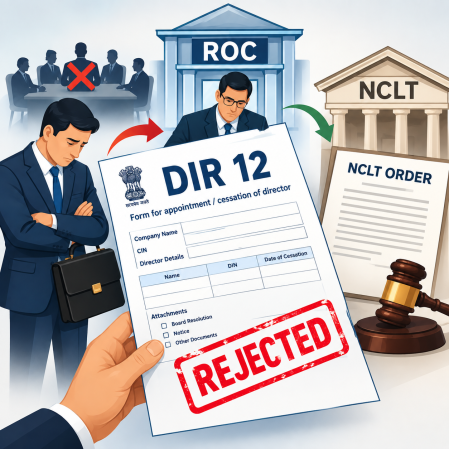
The company subsequently filed Form DIR-12 on 1 February 2025 to record their cessation.
The ROC, however, marked the Form DIR-12 as “Invalid – Not Taken on Record.” The ROC's response indicated that objections had been received from the directors proposed to be removed and that there were disputes concerning the management of the company. The ROC subsequently did not take two further DIR-12 filings concerning the same cessation on record either.
The dispute was not confined to the validity of the removal process. The outgoing directors raised issues relating to the requisitioning shareholder, conduct and participation in Board proceedings, the EGM, authority of representatives of certain corporate shareholders, the registered office, a Development Agreement and financial transactions.
The company consequently approached the NCLT under Section 424 of the Companies Act, 2013 read with Rule 11 of the NCLT Rules, 2016.
Statutory Framework: Section 169 and Rule 11
Section 169 provides the substantive statutory mechanism for removal of directors. Sub-section (1), in relevant part, provides:
“A company may, by ordinary resolution, remove a director…”
The provision makes such removal subject to a reasonable opportunity of being heard and also incorporates the requirement of special notice. Section 169 consequently protects the procedural rights of the director while recognising the statutory power of members to remove a director in accordance with the Act.
Rule 11 of the Companies (Registration Offices and Fees) Rules, 2014 is particularly important in the context of DIR-12. It provides that, before approving or invalidating DIR-12 in cases of vacation or removal of directors, the ROC is required to verify the correctness of the contents and the adequacy of specified supporting documents, including Board resolutions, notices and relevant minutes.
The Rule further provides that where verification reveals a violation of the Act or Rules, the ROC is required to refer the matter to the concerned Regional Director, who is to enquire into the matter after giving the removed or vacated director an opportunity of being heard and communicate the decision to the ROC within the prescribed period.
Thus, Rule 11 itself demonstrates that DIR-12 relating to removal is not necessarily an automatic straight-through filing.
The Central Legal Question Before the Tribunal
The NCLT narrowed the controversy to the ROC's refusal to take DIR-12 on record.
The Tribunal expressly recorded:
“The question before us is whether such action was in accordance with the statutory procedure governing DIR-12.”
The real issue was therefore not whether every objection raised by a director must result in suspension of DIR-12. Nor was the Tribunal called upon to finally determine every dispute between the parties.
The question was whether, having received objections, the ROC had acted within the scope of Rule 11 when it marked DIR-12 as invalid.
This distinction is important. The ROC has a statutory duty to verify compliance, but the existence of a dispute does not automatically transform that verification exercise into an adjudication.
What the ROC Had Done and Why the NCLT Found the Approach Deficient
The Tribunal NOT ONLY accepted that the ROC was entitled to consider the objections raised by the outgoing directors. Indeed, the Tribunal ALSO expressly rejected the proposition that the ROC must mechanically accept every DIR-12 relating to cessation.
However, the Tribunal found a critical deficiency in the ROC's response.
The ROC had stated that the form was not taken on record after considering the objections and documents submitted by the directors. But, according to the Tribunal, the ROC had not identified:
- the particular provision of the Companies Act allegedly violated; or
- the specific defect in DIR-12; or
- the deficiency in the supporting documents discovered through the Rule 11 verification.
“The NCLT therefore observed that the ROC's decision lacked the specific statutory foundation required for invalidating the filing”
This is perhaps the most important practical aspect of the decision. An objection is not itself a statutory violation. An objection must disclose something which, upon verification, amounts to non-compliance with the Act or Rules.
ROC Cannot Become an Adjudicating Forum for Inter-Se Disputes
The Tribunal drew a clear jurisdictional boundary.
It held that the ROC must verify statutory compliance and supporting documents, but cannot decide complicated disputes relating to contractual rights, private arrangements, title, financial claims or the ultimate validity of disputed corporate acts.
The judgment therefore distinguishes between two categories of objections.
The first consists of objections which demonstrate a possible statutory defect, for example, absence of a required notice, defective corporate resolution, inadequate supporting documents or non-compliance with a specific provision of the Act or Rules. Such objections fall within Rule 11 scrutiny.
The second consists of disputes which may be substantial but require adjudication by a competent court or tribunal, for example, competing contractual claims, financial disputes or allegations concerning the underlying commercial relationship between the parties. However, such disputes cannot, by themselves, justify rejection of DIR-12.
The NCLT specifically declined to determine the validity of the requisition, Board Meeting, EGM, authority of shareholders or their representatives, Development Agreement, financial transactions or registered-office disputes.
Comparison with Shumita Kakkar and Brijsons Hotel
The decision becomes more significant when read with two recent 2026 decisions which were themselves cited before the NCLT.
In Shumita Kakkar v. Registrar of Companies, Haryana & Ors., decided by the Punjab and Haryana High Court on 21 April 2026, the petitioner apprehended that DIR-12 might be filed recording her removal as director while an arbitration-related dispute was pending. The High Court noted that Rule 11 requires the ROC to verify the relevant documents before approving or invalidating DIR-12. Since DIR-12 had not yet been filed, the Court held that the Rule had not yet become operative and observed that the ROC would be required to act in accordance with Rule 11 when the filing was made.
Brijsons Hotel Private Limited & Anr. v. Union of India & Ors., decided by the Calcutta High Court on 6 May 2026, involved an allegation that directors had been wrongly shown as having ceased to hold office pursuant to an alleged resignation. The petitioners had complained to the ROC. The High Court directed the ROC to consider the representation and give an opportunity of hearing to the concerned parties, while expressly leaving the merits open.
Satyanand Estate brings these principles together. The ROC must act when DIR-12 is filed it must undertake the Rule 11 verification objections cannot simply be ignored but the ROC must also remain within the boundaries of its statutory function.
The NCLT’s Final Direction
NCLT set aside the ROC's decision marking DIR-12 as invalid and directed the ROC to reconsider and process the form after undertaking the statutory verification required under Section 169 and Rule 11. If the ROC finds a specific violation, it must follow the procedure prescribed under Rule 11 and take a reasoned decision.
The Tribunal expressly clarified that it had not expressed an opinion on the validity of the resolutions dated 3 January 2025 or on the other underlying disputes. The company's request for a direct direction to remove the names of the two directors from the statutory records was consequently not granted at that stage.
Key Takeaways for Company Secretaries and Companies
The judgment provides a practical framework for handling contested DIR-12 filings.
First, DIR-12 following removal of a director should not be treated as a purely mechanical filing. Rule 11 expressly requires verification.
Second, the ROC should identify the precise statutory deficiency if it proposes to invalidate or withhold a DIR-12. A general reference to “management disputes” is insufficient.
Third, objections from the outgoing director have to be considered, but only within the statutory framework. Their existence does not automatically prevent recording of cessation.
Fourth, ROC cannot adjudicate on the basis of inter-se disputes. Matters requiring determination of contractual rights, financial claims or other private disputes must be pursued before the competent forum.
Fifth, the company filing DIR-12 should maintain a comprehensive documentary trail demonstrating compliance with Section 169 special notice, notices to the concerned director, opportunity to make representations, Board proceedings, EGM notice, attendance and minutes and the relevant resolution.
Finally, the judgment establishes a useful middle ground, the ROC is neither a rubber stamp nor a court. Its duty is to verify statutory compliance, identify genuine statutory defects and invoke the Rule 11 mechanism where necessary, while leaving adjudication of substantive private disputes to the forum legally empowered to decide them.
In practical terms, Satyanand Estate therefore strengthens the proposition that a disputed DIR-12 must be dealt with through a reasoned statutory verification process, rather than either automatic acceptance or rejection merely because an outgoing director has raised objections.

