


Streamlining Adjudication at the NCLT: A Step Towards Efficient Justice Delivery
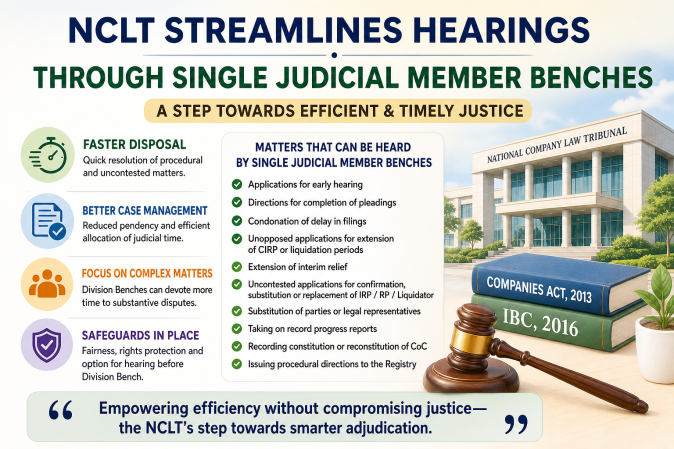
"“Empowering efficiency without compromising justice - The NCLT’s step towards smarter adjudication.”
Streamlining Adjudication at the NCLT: A Step Towards Efficient Justice Delivery
On 27 April 2026, the National Company Law Tribunal (NCLT) issued a significant administrative order permitting Single Judicial Member Benches to hear and dispose of specified categories of matters under the Companies Act, 2013 and the Insolvency and Bankruptcy Code, 2016 (IBC). This order, which came into immediate effect, applies uniformly to all benches of the Tribunal across India unless specifically directed otherwise. The move reflects a pragmatic and progressive approach toward addressing mounting case backlogs and enhancing the efficiency of quasi-judicial functioning.
Statutory Framework and Legal Basis
The order has been issued in exercise of powers under the proviso to Section 419(3) of the Companies Act, 2013. As per the main provision of Section 419(3), the powers of the Tribunal are ordinarily exercised by a Division Bench comprising one Judicial Member and one Technical Member. This dual-member structure is designed to ensure a balanced adjudication by combining legal expertise with domain-specific technical knowledge.
However, the proviso to the same section confers flexibility upon the President of the NCLT to constitute Single Judicial Member Benches and specify the categories of cases that may be handled by such benches. The intent behind this proviso is to facilitate administrative efficiency without compromising the quality of justice. The 27 April 2026 order is a direct invocation of this enabling provision.
Rationale Behind the Order
The NCLT has, over the years, faced increasing pressure due to rising litigation under both corporate law and insolvency regimes. Delays in disposal of cases—particularly procedural and uncontested matters have often led to inefficiencies and increased costs for litigants.
Recognising this challenge, the Tribunal has acknowledged that a substantial portion of cases brought before it are procedural, routine, or uncontested in nature. These matters do not necessarily require the deliberation of a full Division Bench. By delegating such cases to Single Judicial Member Benches, the Tribunal aims to:
- Reduce Pendency: Freeing up Division Benches to focus on complex and contested matters.
- Improve Case Management: Streamlining workflow and minimizing procedural bottlenecks.
- Enhance Speed of Disposal: Ensuring timely resolution of routine applications.
- Optimize Judicial Resources: Making effective use of available judicial capacity.
This reform reflects a shift toward a more differentiated and pragmatic case allocation system within the Tribunal.
Categories of Matters Covered
The order clearly delineates the classes of cases that can now be heard and disposed of by Single Judicial Member Benches. These primarily include procedural, non-contentious, and urgent matters such as:
- Applications for early hearing
- Directions for completion of pleadings and compliance
- Condonation of delay in filings (applications, replies, affidavits)
- Unopposed applications for extension of Corporate Insolvency Resolution Process (CIRP) or liquidation timelines
- Extension of interim relief granted by Division Benches
- Uncontested applications for confirmation, substitution, or replacement of Interim Resolution Professionals (IRP), Resolution Professionals (RP), or Liquidators
- Substitution of parties or legal representatives
- Taking on record progress reports submitted by insolvency professionals
- Recording constitution or reconstitution of the Committee of Creditors (CoC)
- Issuing procedural or administrative directions to the Registry
These matters are largely facilitative in nature and do not involve substantial adjudication of disputes affecting rights or liabilities.
Built-in Safeguards
While the order significantly expands the scope of Single Member adjudication, it also incorporates essential safeguards to maintain the integrity of the adjudicatory process.
Firstly, the order provides that if any party to the proceedings requests that a matter be heard by a Division Bench, such a request will be honoured. This ensures that litigants retain the option of having their case heard by a broader bench where necessary.
Secondly, contested matters involving substantive rights are explicitly excluded from the jurisdiction of Single Judicial Member Benches. This is a critical safeguard, as it ensures that complex disputes continue to receive the benefit of dual-member deliberation.
Thirdly, matters falling outside the specified categories cannot be taken up by Single Member Benches. This prevents jurisdictional overreach and ensures adherence to the statutory framework.
Collectively, these safeguards strike a balance between efficiency and fairness, ensuring that expedited procedures do not come at the cost of justice.
Impact on Insolvency Proceedings
The order is particularly significant in the context of insolvency proceedings under the IBC. Timelines are central to the insolvency framework, and delays especially in procedural approvals can derail resolution processes.
By allowing Single Judicial Member Benches to handle routine insolvency-related applications such as extension of CIRP timelines (when unopposed), replacement of resolution professionals, and recording CoC changes, the Tribunal has effectively reduced procedural friction. This is likely to result in faster progression of insolvency cases and better adherence to statutory timelines.
Administrative Efficiency and Judicial Reform
This move can also be viewed as part of a broader trend toward administrative reforms within tribunals in India. With increasing case loads and limited judicial capacity, institutions are being compelled to innovate in terms of case allocation and management.
The introduction of Single Judicial Member Benches for specified matters is a practical solution that aligns with global best practices in tribunal administration. It reflects an understanding that not all matters require the same level of judicial scrutiny and that procedural efficiency can coexist with substantive fairness.
Potential Concerns and Considerations
While the order is largely welcomed, certain concerns may arise in its implementation. For instance, determining whether a matter is truly “uncontested” or “procedural” may sometimes involve subjective judgment. There is also a need to ensure consistency across benches in interpreting the scope of the order.
Moreover, adequate training and administrative coordination will be essential to ensure smooth functioning. The Registry will play a crucial role in correctly categorizing cases and placing them before the appropriate bench.
Conclusion
The 27 April 2026 order of the NCLT marks a significant step toward enhancing the efficiency and responsiveness of India’s corporate adjudicatory framework. By leveraging the statutory flexibility under Section 419(3) of the Companies Act, 2013, the Tribunal has introduced a pragmatic mechanism to deal with routine and procedural matters more expeditiously.
At its core, the reform seeks to balance two critical objectives speed and justice. By reserving complex and contested matters for Division Benches while delegating routine issues to Single Judicial Members, the NCLT has created a more streamlined and effective adjudicatory model.
If implemented effectively, this initiative has the potential to significantly reduce pendency, improve litigant experience, and strengthen confidence in the Tribunal system. It is a welcome development that underscores the evolving nature of judicial administration in India.

